The Design Office
AI deliverable monitoring
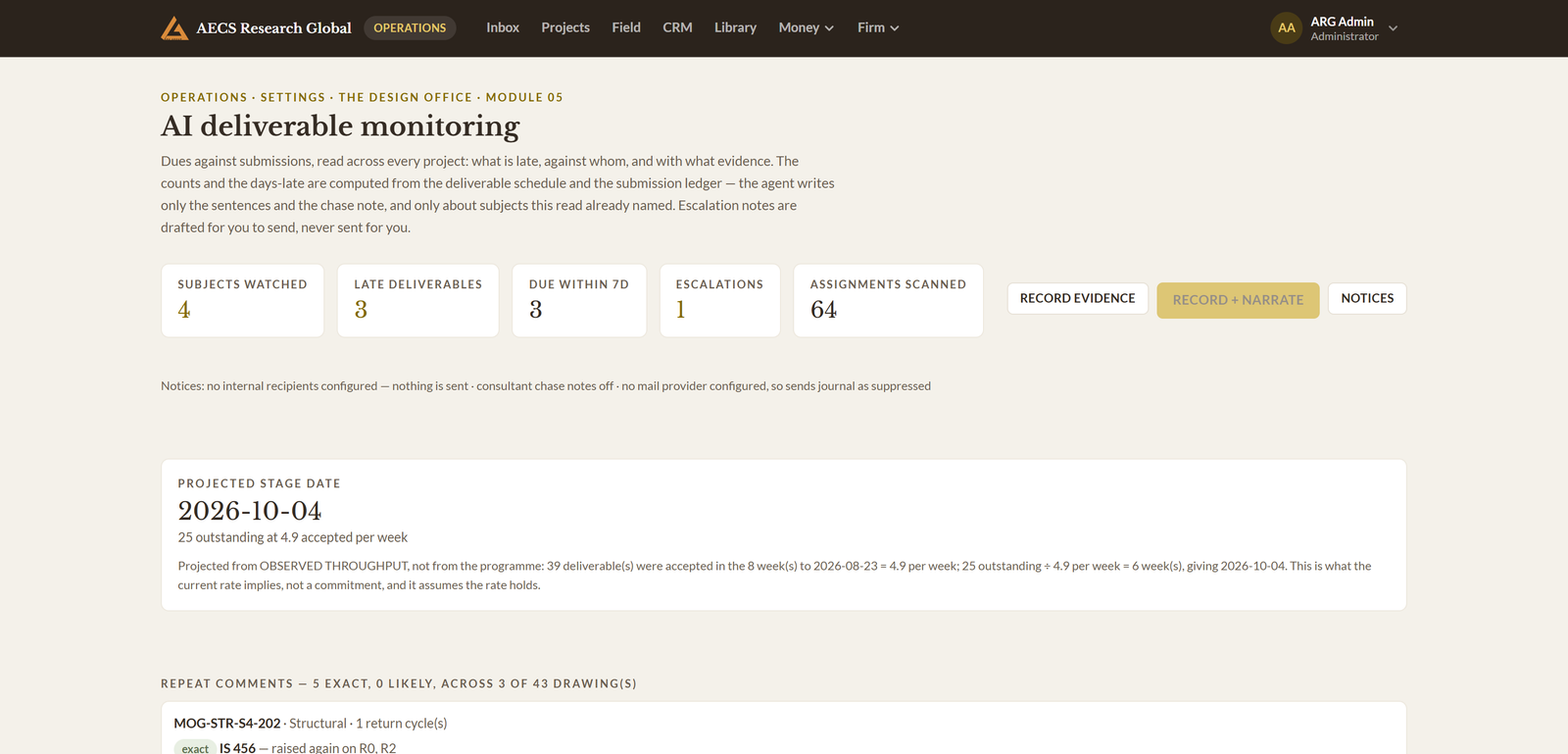
Dues against submissions, read across every project: what is late, against whom, and with what evidence. The figures are computed from your own deliverable schedule and submission ledger; the agent writes the chase note that goes with them, for you to send.
What it watches
Due-versus-submitted, per consultant
Every open deliverable with days remaining or days late, grouped under the firm contractually bound to it — or under the owner role where no firm is bound, which is itself a finding.
Review latency on your own side
Packages waiting on your comment beyond the appointment’s review period — the delays a consultant will rightly put back on the practice. Counted from the review date the platform stamps at submission; a package with no stamped date is reported as undated, never as on time.
A chase note you can actually send
For each subject, a courteous note drafted from that subject’s own evidence — and nothing else. It cannot state a count, a date or a firm name of its own: those come off the ledger.
Its own verdict, next to yours
The platform computes chase or escalate from the days late. Where the agent reads it differently, both verdicts are shown side by side rather than one quietly replacing the other.
How it reaches you
- A watchlist you can run on demand, and a standing rule on the automations lane
- Every run appended to the same append-only trail the other automations write to
- Escalation notes drafted for you to send, never sent for you
What it will not allow
- A narrative about a consultant the evidence never named
- A count, a date or a firm name asserted by the agent rather than the ledger
- A silent run — a firing is recorded even when there is nothing to say
What a watchlist entry looks like — illustrative, not a live read