The Design Office
Billing & GST invoicing
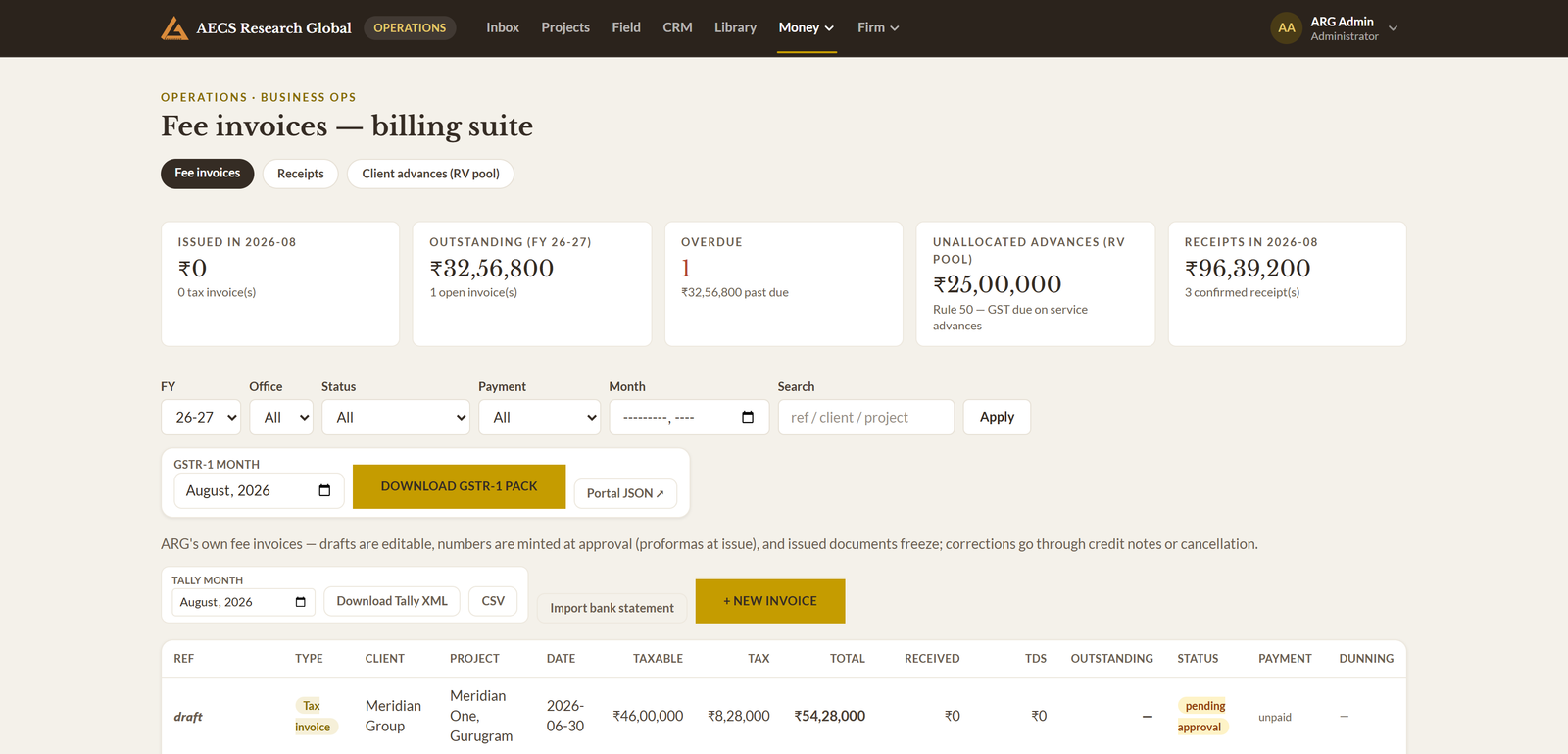
Fee invoices raised against a completed stage, numbered on approval, frozen on issue, and GST-correct without an accountant re-keying them.
- Partner
- Accounts
- Practice manager
In a practice. Fee invoices in a design office are late for one of two reasons: nobody was sure the stage was complete, or nobody wanted to ask. Both disappear when the invoice is raised from the stage record — the evidence is attached, so the invoice is not a request for trust, it is a statement of fact.
What it holds
Stage-linked fee invoices
The invoice references the stage, the appointment’s fee percentage and the accepted deliverables that completed it. Rule-46 fields, HSN/SAC, place of supply and the reverse-charge position are all derived, not typed.
GST handled properly
CGST/SGST or IGST decided by place of supply, site-versus-office rule applied, SEZ and LUT zero-rating supported, TDS and GST-TDS expectations recorded so a short payment reconciles instead of confusing everyone.
Receipts, credit notes and the ledger
Receipts allocated against invoices with TDS captured, credit notes inside the section-34 window, and an outstanding ledger aged by bucket per client.
GSTR-1 export
A filing workbook out of the same ledger the practice runs on, including amendments and the void table — so the return and the accounts agree by construction.
The controls
- Four-eyes. The person who drafts cannot approve. Enforced by the server, not by habit.
- Number on approval. The invoice reference mints when it is approved — no gaps, no reuse.
- Freeze on issue. An issued invoice cannot be amended; a correction is a credit note.
- Hash recorded. The issued PDF’s fingerprint is stored with it.
What it will not allow
- Self-approval of your own invoice
- Editing after issue
- Over-allocating a receipt beyond the invoice