The Design Office
Design-stage cost management
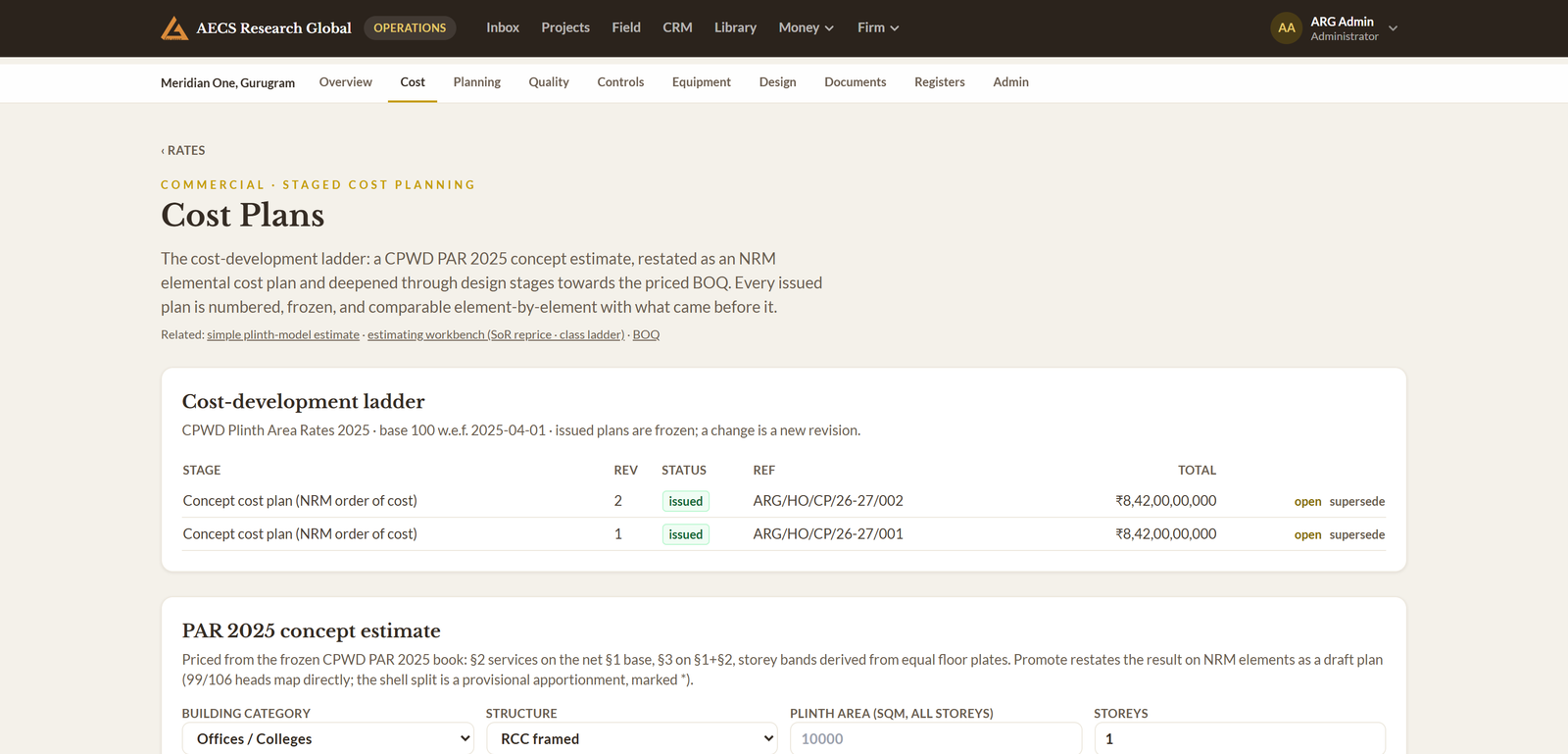
One cost record that matures with the design — order of cost, schematic plan, NRM elemental plan, measured BOQ, specification — each stage inheriting the last and explaining the difference.
- Principal
- In-house QS
- Cost consultant
In a practice. The cost conversation is where design authority is won or lost. A practice that can say "the budget moved by 6.4% and here are the four design decisions that moved it" keeps control of the scheme. A practice that produces a new spreadsheet each stage gets value-engineered by someone else.
What makes it one record
Each stage inherits the last
A new stage opens from the prior one, so nothing is retyped and nothing is silently dropped. The lineage from order of cost to tender sum is a single traceable chain.
Movement, reconciled and attributed
Every difference between stages is a line: design change, quantity refinement, rate movement, scope addition or allowance release. The client sees why, not just how much.
Sourced rates, always
Each rate is tagged to its origin — [CPWD DSR], [Vendor], your own analysis or a recommendation. Nothing sits in a cost plan with an unexplained number.
Value-engineering options held, not lost
Options are recorded with their saving, their design consequence and their decision — accepted, rejected or parked — so the same idea is not re-argued at the next stage.
Why a practice sells this
Design-stage cost advice is a fee line most architectural offices give away inside the design fee. Issued as a stage deliverable — dated, sourced and reconciled — it becomes a billable service and, more usefully, the reason the client believes your scheme is affordable.
What it will not allow
- A stage that does not reconcile to the previous one
- An untagged rate in an issued plan
- Editing an issued cost plan — it supersedes
The cost-plan ladder
01
Conceptual cost plan
Order of cost from area schedule and functional-unit rates, benchmarked against your delivered projects. States its own accuracy band and its exclusions.
Issued at concept sign-off
02
Schematic cost plan
Carried into the schematic with named allowances, provisional sums and a stated design-development margin. Every movement from stage 01 is listed with its cause.
Issued at schematic gate
03
NRM elemental plan
Elemental breakdown to NRM — substructure, superstructure, finishes, services, external works, preliminaries — so value engineering has a defined target instead of a percentage cut.
Issued at design development
04
Detailed BOQ
Measured bill on DSR / DAR libraries or your own firm rates, with rate analysis behind each item and a source tag on every rate.
Issued for tender
05
Technical specification
Specification built up item by item against the BOQ, versioned with the tender it was issued in, so award, execution and audit read the same clause.
Issued with the tender